


You sit down to eat, and within twenty minutes a sharp, gnawing pain settles in behind your ribs. For people living with Median Arcuate Ligament Syndrome (MALS), that scene repeats meal after meal, sometimes for years, before most gastroenterologists discover what is actually happening.
MALS affects approximately two per 100,000 people according to The National Organization for Rare Disorders, and that rarity is part of why it slips past so many GI doctors. So how long can you safely wait once a MALS diagnosis is on the table?
While MALS usually isn’t an emergency, it is not a condition you can leave alone forever, either. Read on to learn the risks of untreated compression, the signs that mean it is time to escalate your care, and where to find the best MALS specialist in Los Angeles.
What is Median Arcuate Ligament Syndrome (MALS)?
MALS is a condition where a fibrous band of tissue under the diaphragm presses on the celiac artery and the cluster of nerves wrapped around it, cutting blood flow to the upper digestive organs and firing off pain signals in the process. Because the symptoms look so much like IBS, gastroparesis, or even an eating disorder, most patients cycle through specialists and rounds of testing before getting a clear answer.
What Happens if MALS Goes Untreated?
When the celiac artery stays compressed for months and years, your body starts working around the problem. It opens up new pathways for blood flow, the nerves around the artery stay irritated, and the surrounding tissue slowly remodels itself. None of that registers as an emergency, but each piece of that adaptation can become harder to reverse the longer it sits.
Many patients spend two to seven years bouncing between specialists before being referred to the best MALS doctor in Los Angeles for an accurate diagnosis and effective treatment. During that long stretch, pain pathways in the brain and spinal cord begin to rewire, food avoidance becomes automatic, and small vascular damage builds up. The mental toll is real, too. Living with chronic pain through years of inconclusive testing often leads to depression and anxiety that the Cleveland Clinic flags as a regular part of the MALS experience.
Can Untreated MALS Cause Permanent Vascular Damage?
The celiac artery delivers blood to the stomach, liver, spleen, and parts of the pancreas. When that vessel is squeezed for years, your body keeps blood moving by opening up smaller backup routes, mainly through the pancreaticoduodenal arteries near the pancreas. These backup vessels are not built to carry that kind of pressure long term, so over time they can balloon out into aneurysms, and a ruptured aneurysm deep in the abdomen is a life-threatening bleed that can come on with very little warning. This is why it’s important to get a thorough evaluation from the best MALS doctor in Los Angeles as soon as possible.
How Does Untreated MALS Affect Nutrition and Weight?
For most MALS patients, the hardest part of eating is postprandial pain, the deep twisting abdominal pain that usually starts about twenty to sixty minutes after a meal. This usually leads to skipping meals, choosing smaller portions, and cutting out the foods that seem to set off the worst attacks. Many MALS patients lose more than twenty pounds before they ever hear the diagnosis, and a smaller group end up needing IV nutrition or a feeding tube to stay safe.
When Should You Have MALS Surgery? Signs You Can't Afford to Wait Longer
There are several signs that signal it’s time to find a provider who offers the best MALS surgery in Los Angeles:
- Rapid or severe weight loss is one
- Trouble keeping fluids down is another
- Imaging that shows aneurysms forming in the backup vessels
- Heavy collateral circulation
- Non-surgical treatment options, like a celiac plexus block that temporarily numbs the celiac nerves, don’t work
While waiting for MALS surgery, treatments like dietary changes, pain management, mental health support, and nutrition therapy can temporarily make symptoms more manageable.
Where to Find the Best MALS Doctor in Los Angeles
MALS is a complicated condition that is rare enough that most inexperienced GI doctors are not able to accurately diagnose and treat it. And living with its debilitating symptoms can have a serious impact on your physical and mental health. This is why people from across the United States come to Dr. Danny Shouhed, who is one of the most experienced MALS surgeons in the country.
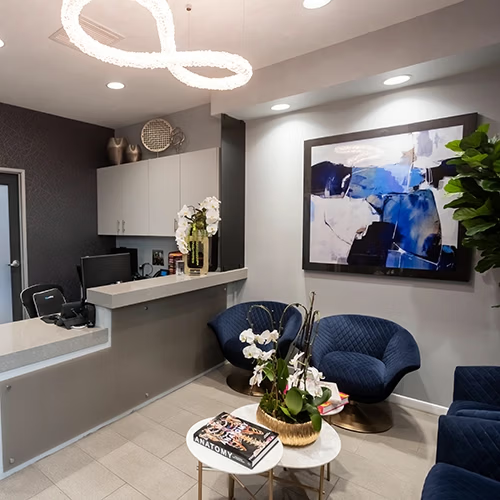
At our state-of-the-art office in Los Angeles, our team of MALS experts offers the most comprehensive evaluations and the most advanced treatment options for MALS, including minimally invasive procedures.
Ready to get fast, effective relief with the best MALS doctor in Los Angeles?
What Our Patients Say About MALS Surgery with Dr. Shouhed


I had my MALS & SMAS surgery with Dr Shouhed! Anyone that I come in contact with that may have compression syndromes I recommend him, my experience has been more than amazing. And I’m so thankful for their entire team!



.svg)

Send Us a Message to Schedule Your Appointment
Fill out the form to get started with Dr. Danny Shouhed, MD


.avif)



.svg)
.svg)
.svg)
.svg)

.svg)

.svg)